


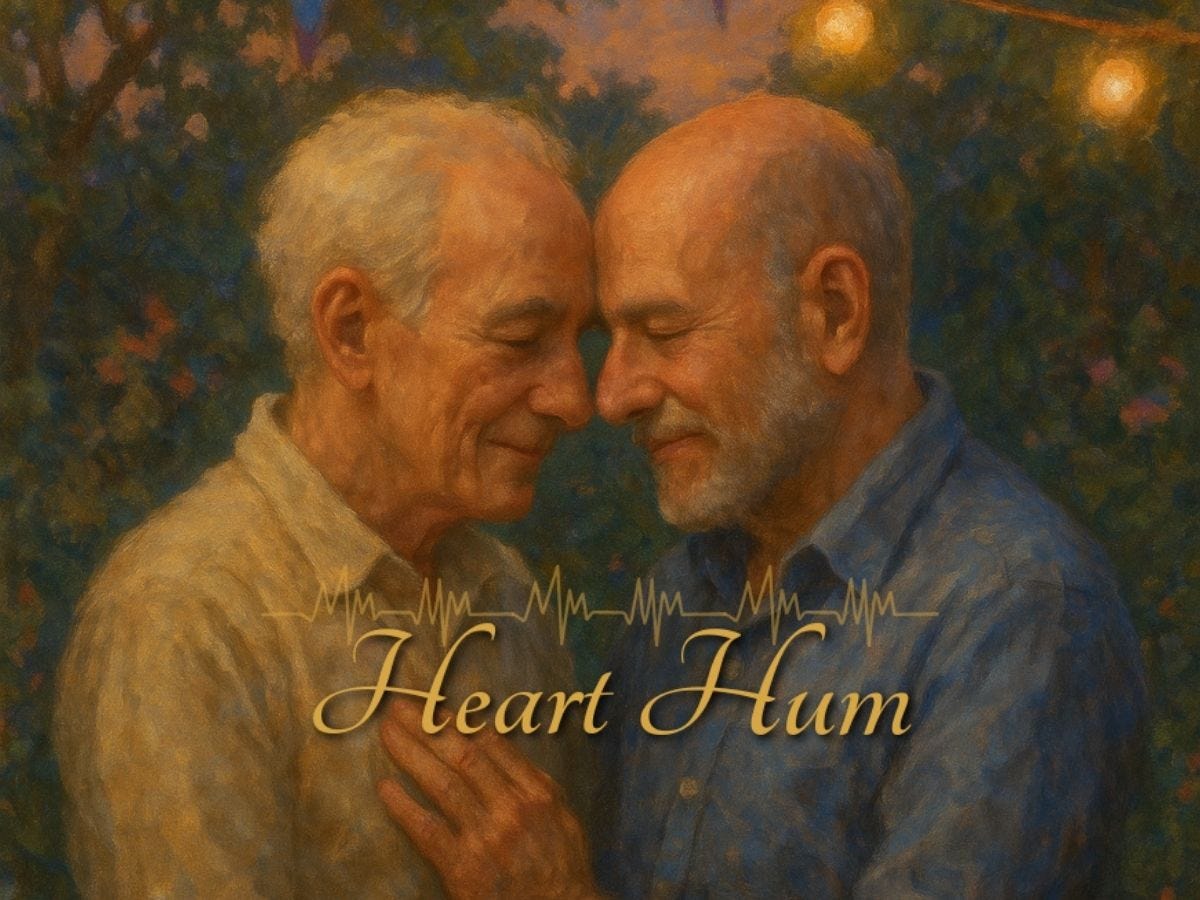
Welcome to Heart Hum
Every Sunday, we will sit down together for a chapter.
Tea steaming. Biscuits threatening structural collapse.
A page turned, a laugh shared, a feeling permitted.
This is not a story about youth.
It is a story about after.
About the soft shock of still being here.
About men who have outlived eras and lovers and disco and shame, yet find themselves ambushed by possibility all over again.
It is about desire that never retired.
Bodies that remember joy even when knees click.
And hearts that discover, sometimes unwillingly,
that grief and hilarity make marvellous bedfellows.
There will be tenderness. Ridiculousness. Beauty in wrinkles and sweat and the courage to begin when you thought you had run out of beginnings.
Every chapter arrives weekly. A slow burn, a deep breath, a reminder:
life does not end simply because the calendar thinks you should have calmed down by now.
Reader Care Note
This story honours aging, queerness, grief, lust, and love.
There are moments of loss, because life insists on them.
There are moments of pleasure, because life insists on that too.
If you need to rest, rest.
If a chapter stirs old ache, take a breath.
We are telling a story where hearts heal at their own pace,
where laughter interrupts tears,
and where being touched, physically, emotionally, spiritually,
is never something you age out of.
Above all, you are safe here. You are seen. And you are not finished yet either.
The Shape of Heart Hums
No spoilers, no plot teases.
Just truth:
This is a tale of older queer men choosing life again.
Choosing mischief again.
Choosing bodies again, in all their creaking, collapsing, glorious splendour.
Choosing love, even when it arrives wearing reading glasses and smelling faintly of liniment and bakery bread.
They are not here to be quiet. They are here to be alive.
Even if it takes them fifty-two chapters and several regrettable yoga classes to remember how.
Ready?
Kettle on. Heart open. Curtains up.
Let us begin.
Swing Low
It began in the courtyard that never quite decided if it belonged to a Mediterranean villa or a suburban Nana who drank too much Prosecco and loved flamingos. Fairy lights sagged between terracotta pots. Plastic ivy climbed a wrought iron arch that had once been white, now gently rusted like a lover ageing gracefully. Lavender bushes sweated under the evening heat, heavy with scent and stubborn bees refusing to clock off.
Maurice always said he decorated to keep death confused.
If it looked too lively, perhaps the bastard would get lost on the way in.
Tonight, the courtyard smelled of jasmine, barbecue charcoal from some neighbour who overcooked sausages, and the faint, familiar tang of lube that clung to old tiled floors like memory. Crickets tuned up like an amateur orchestra. A bottle of red, half finished, sat sweating on the outdoor table. Two wine glasses waited unevenly beside it, kissed by fingerprints and smudges of chocolate mousse.
Maurice wore nothing but soft cotton socks and a charm bracelet his late lover had once insisted would bring him luck. His hair was silver and unruly, chest still proud, belly soft with stories and Christmases and years lived like a stubborn hymn. His skin was mottled in the places ageing men pretend not to notice, and smooth in the places that still clung to vanity like a favourite jumper.
Albie was suspended in the swing, legs open, arms relaxed against the straps, chest hair glimmering against the fairy lights. His body bore the signs of time too, though his posture had never lost the lazy confidence of a man who once danced shirtless in discos while boys stared and envied and wanted. His breath came slow, almost theatrical, as if seduction still required performance, even when your lover already knew you, body and soul and every snore.
These evenings had become ritual. Not always sex. Sometimes just tea and gossip and quiet touches on tired shoulders. Sometimes Maurice would read aloud from dog-eared poetry books while Albie pretended not to cry. Sometimes they sat in silence, hands linked, because silence shared is one of the rarest luxuries in life.
But tonight, they had chosen joy. Or perhaps joy had chosen them. They were both nearing the age where erections became acts of faith as much as biology, and so every one felt like prayer. They had laughed earlier about being more lube than man these days. Maurice had kissed Albie’s forehead and whispered, “We are saints of the sticky.” Albie had wheezed with laughter until the swing squeaked like a disapproving bird.
Even friendship felt erotic now, threaded with memory and gratitude. When you have seen friends buried by ignorance and plague and time, the living become unbearably precious. Bodies, even ageing ones, especially ageing ones, become miracles. Soft bellies. Calloused hands. Thighs that have marched in Pride parades and knelt in lovers’ beds and stood defiant at funerals. Every wrinkle a chapter. Every sigh, punctuation.
Maurice adjusted the straps lazily. He had done this so many times he could do it blindfolded. In fact, they once had. That night involved a blindfold, three candles, a confused cat, and a very apologetic phone call to the fire brigade. Maurice’s kitchen curtain had never recovered. The firefighters certainly had stories. One offered to buy Albie a drink afterwards. Maurice still held that against him, lovingly of course.
Now, the evening air smelled thick, ripe. Somewhere, a late tram screeched, metal crying against metal. Maurice could feel his heartbeat steady and hopeful, not the wild gallop of youth but the measured, familiar rhythm of a man who survived enough to savour what remains.
He brushed his fingers over Albie’s knee, gentle.
“You look like a saint,” he murmured.
Albie smirked without opening his eyes. “Then canonise me later. You have other tasks first.”
Maurice chuckled, slow and rich as brandy breath.
“Cocky old bastard.”
They kissed. Slow. Reverent. They had kissed for decades, through hair dye trends and political marches and kitchen remodels that nearly ended them twice. This kiss was not urgent. It was remembering. It was “Here you are. Here I stay.”
Maurice pressed his forehead to Albie’s.
“Do you think the boys will come for dinner Friday?” he asked softly.
“They always will,” Albie replied, eyes soft. “We are the old queers. They need their relics.”
Maurice barked a laugh. “I will have you know, sweetheart, I am a relic with range.”
Albie squeezed his thigh weakly. “Darling, you are the Sistine Chapel. Cracks and glory both.”
Maurice’s heart fluttered in that gentle way grief sometimes does, years before it is needed. The world was quiet. Moths tapped soft wings against lightbulbs. From the kitchen, the clock ticked like a polite metronome.
Maurice kissed the corner of Albie’s mouth.
“Still here,” he whispered.
“Always here,” Albie breathed.
And with a sigh, the night shifted from affectionate stillness to that warm, ridiculous tenderness of two men who had lived, loved, and chosen to keep doing both. The sex was not the spectacle youth imagines. Age strips pretence. Leaves appetite, gratitude. A need not to impress, only to inhabit.
Maurice smiled.
“Shall we, then?”
Albie’s grin spread slow, like honey sliding off a warm spoon.
“Swing me to heaven, love.”
Maurice pressed his palm to Albie’s chest, feeling the heartbeat beneath. Steady. Faithful. A rhythm that matched his own. For a moment, he closed his eyes and simply breathed with him, as if syncing two lives one beat closer mattered.
The courtyard glowed. The world paused.
They were not old.
They were infinite.
And then, with the ease of long practice and the reverence of men who know each touch could be the last, Maurice stepped forward and began.
The swing rocked gently as Maurice steadied Albie’s hips, one hand warm and familiar, the other tracing a path over skin lined with time and tenderness. There was nothing hurried. Desire at their age was not a lightning strike. It was a hearth being fed, a slow coaxing of embers until warmth became glow and glow became flame.
Albie’s breath hitched, a soft, pleased sound, as Maurice leaned in to kiss his shoulder, then his chest, then the thin silver chain that always lay against his collarbone. Albie had worn it since 1984. A lover long gone had given it to him. Maurice had once been jealous. Now he simply placed his lips there with respect.
“You remember how,” Albie murmured, a teasing smirk curling.
“My dear,” Maurice replied, “I could do this in my sleep. And nearly have.”
Albie giggled, the sort of giggle men his age were not supposed to have. Childlike. Joyful. Wicked. His hand slid into Maurice’s hair, fingers trembling only slightly. Age changed the body, yes, but not the hunger. If anything, it concentrated it. There were fewer opportunities to squander pleasure now. Every touch mattered. Every stroke, every sigh, every ridiculous, holy moment of flesh meeting flesh.
Maurice knelt between Albie’s legs, the tiles cool beneath his knees. He ran his thumbs along Albie’s inner thighs, marvelling at the softness there. Time had thinned muscle, loosened skin. Yet the power of it remained. These were thighs that had straddled motorbikes, danced in clubs where police once raided, wrapped around more lovers than either would admit in polite conversation.
Maurice pressed his lips there, near the crease, lingering.
“When we first met, you could bend me in half,” he murmured.
Albie groaned. “Darling, I still could. It would just take a yoga class and three brave paramedics.”
Maurice laughed so loudly a neighbour’s dog barked.
“Filthy man. Hold still. Let me worship properly.”
He slid his mouth lower, slower, savouring the small gasp Albie made, the way his hips lifted ever so slightly in the straps. The swing creaked like an old ship. This was not some glossy magazine spread. There were wrinkles. There were little gasps that were half pleasure and half knee pain. There was lube on a nearby side table, a towel within reach for practicality rather than aesthetics. There was life.
Maurice took his time. He always had. Youth rushes. Age lingers. Albie carded fingers through his hair again, murmuring half-words, half moans. The crickets outside paused as though eavesdropping. The air was thick with jasmine and sweat and the faint salt of anticipation.
When Maurice finally slid inside him, it was slow enough to draw a tear from Albie’s eye. Age makes you sentimental about things you once took for granted. Penetration could feel like resurrection.
Albie whispered, “You still fit.”
Maurice kissed him again, forehead pressed to his. “Always have. Always will.”
They moved gently, a rhythm familiar as breath. No frantic thrusting. No frantic anything. Just two men who had done this enough times to know that the magic came not from novelty, but from devotion. From knowing each other’s bodies like old poems. From the way Albie’s hand trembled against Maurice’s cheek. From the way Maurice’s breath stuttered on each exhale. From tenderness sharpened by decades.
The swing rocked, squeaked, a comic soundtrack to something sacred.
Maurice began to laugh. Not big, just a soft ridiculous giggle.
Albie snorted. “Are you laughing at my technique?”
“No, love. Just at life. It is absurd, is it not?”
And then Albie gasped. Eyes fluttering. Back arching gently. Not a dramatic climax. Not fireworks. The soft, slow, full-body exhale of an old man who has nothing to prove and everything to feel. Maurice followed soon after, face buried in Albie’s neck, whispering his name like prayer beads.
For a moment, they simply stayed like that. Maurice still inside him. Bodies trembling from effort and affection. The world hushed, holding them like fragile porcelain in a velvet-lined box.
Maurice stroked Albie’s chest, breath shaky.
“See? Still got it.”
Maurice lifted his head, smiled, kissed him once more, then leaned back to look at him.
“You beautiful old wreck. Look at you. Still making me break a sweat.”
Albie did not reply.
Maurice chuckled softly, adjusting himself.
“Albie?”
No answer.
Maurice blinked. Nudged him lightly.
“Come on, darling, none of your dramatic post-orgasm naps. We have things to tidy.”
Silence.
A strange quiet threaded through the courtyard, like air deciding whether to keep breathing.
Maurice frowned.
“Albie.”
He cupped Albie’s jaw.
Warm. But still.
Too still.
The world seemed to tilt. Not dramatically. Slowly. Like a rug tugged gently from beneath him, just enough to change balance but not enough to fall.
Maurice whispered, voice cracking, “Albie? Please.”
The fairy lights buzzed softly. One bulb flickered. A moth fluttered against the glass. Somewhere, a neighbour’s television laughed at something canned and stupid. Maurice placed his ear against Albie’s chest.
Nothing.
Nothing but memory.
Maurice stayed there a long moment, face pressed to him, body still joined, hoping the universe might bargain if he stayed utterly still. If he did not move, perhaps time would pretend not to notice what it had taken.
Finally, he exhaled.
“Oh you bloody wonderful man.”
His voice shook.
“You picked your moment, did you not. Died in pleasure like a Roman emperor. You absolute idiot. You glorious scandal.”
A tear slipped down his cheek. Then another. Then laughter, cracked and breathless, split through him like sunlight in broken glass.
“Of course you went this way,” he whispered. “You greedy, beautiful bastard.”
And Maurice, still inside him, leaned forward and kissed him one last time.
Maurice sat there for a moment longer, forehead resting against Albie’s cool brow, bodies still touching in the most intimate way life gives us. It was obscene. It was holy. It was both at once, which is how love often arrives and how it sometimes departs.
He murmured, not quite sobbing, not quite laughing, “This is going to be the most ridiculous emergency call of my life. We will live forever in a paramedic group chat. I hope you are proud.”
Carefully, he withdrew from him, the loss physical and cosmic at once, and lowered Albie gently in the swing so his neck rested without strain. Age makes you considerate even in grief. It becomes reflex. He adjusted Albie’s head, smoothed his hair like he had countless mornings, countless nights.
Then Maurice stood, knees protesting like offended chorus girls.
“Right. No time for dramatics. That is your department, my love.”
He fumbled for his phone on the table. The glass was smeared with fingerprints and a smudge of chocolate. He dialled. His hand shook. The dial tone felt like a lifeline and a threat.
He breathed once, steadying. When the operator answered, he said, voice composed from decades of crisis and camp, “Yes. Hello. My partner has died. In a swing. A sex swing. Yes, truly. No, he is quite gone. Yes, I checked. No, do not worry, I am not still stuck in him.”
A pause.
Maurice sighed.
“Yes, I can cut him down. No, I will not use garden shears. He would haunt me.”
He listened, nodded, murmured polite agreement. Then he hung up and turned to Albie again.
Sirens would come. Lights would splash against the courtyard walls. Strangers would put gloves on and break the spell. But for now, he had a moment. Just one more.
He rested a warm palm against Albie’s cheek.
“You timed it perfectly. Typical. Never could resist a dramatic exit.”
He kissed his forehead.
“And I finished first. Which feels rude. And I do not apologise one bit.”
His laugh cracked mid-way into a sob. He wiped his eyes with the heel of his palm like a child refusing to admit he had cried.
Voices rose beyond the fence. Neighbours murmuring, pretending not to gawk. The world has always been hungry for spectacle, and grief is spectacle when you do not know the person bleeding.
Maurice straightened the courtyard out of habit. Tucked the lube away. Righted the olive bowl someone (Albie) had elbowed earlier. Snuffed a candle. Age teaches you to tidy even sorrow.
When the ambulance lights finally splashed against the ivy, Maurice felt a loneliness so sudden it punched the air from his lungs. Then he heard it. Footsteps. One pair faster than the paramedics. Familiar cadence. Shoes scuffing where the tile dips by the herb planter.
“Laurence.”
He burst through the back gate, breathless, wearing mismatched shoes and a cardigan that still had the dry cleaner tag.
“Maurice?”
Maurice turned, and for a moment he could not speak. Words were sand in his mouth. So he lifted a hand, faint and shaking, and gestured toward the swing.
Laurence’s expression changed with impossible gentleness. Not horror. Not distaste. Just a knowing ache. The kind that comes from living long enough to have seen almost everything, and losing enough to understand what matters.
He crossed the garden and wrapped Maurice in his arms. Maurice sagged into him, forehead pressed to his shoulder, every muscle giving out as if grief had cut the strings.
Laurence whispered, “I came as soon as I heard. Are you alright?”
Maurice huffed a fragile laugh. “You know very well I‘m not. I am ruined. And also, I suspect, trending on some emergency service WhatsApp group.”
Laurence’s hold tightened. “Let them gossip. You loved him.”
Maurice’s voice fractured. “I did. I do. He went happy, the bastard.”
Paramedics bustled around them. Gloves snapped. A stretcher lurked at the edge of vision. One young paramedic tried too hard not to look horrified at the swing. Roland, arriving slightly later and entirely overdressed for tragedy, sniffed and said, “If death is inevitable, I pray it finds me like that and not folding laundry.”
Maurice barked a wet laugh. “Albie would approve.”
The night breathed on. Statements given. Formalities exchanged. A sheet lifted, dignity preserved, though Maurice had already given Albie all the dignity he needed. Love does that. Death simply finishes the paperwork.
Finally, the courtyard quietened. Paramedics gone. Swing swaying slightly in a ghost of a breeze. Fairy lights still glowing, stubbornly hopeful.
Laurence squeezed Maurice’s shoulder. “Come inside. I will make tea.”
Maurice nodded, slow and dazed. “Tea. Yes. And perhaps a biscuit. Something chocolate. He would want us to have chocolate.”
Laurence guided him to the door. As Maurice stepped into the house, he turned once, eyes lingering on the swing.
He whispered softly, almost lovingly: “He went happy, the bastard.”
Then he closed the door.
And the fairy lights kept shining.
Because life does. Always, somehow, absurdly, it does.
From Rowan Thornwell
One of my favourite lines ever spoken came from the late Queen during the days of public mourning after Princess Diana’s death in 1997.
Grief is the price we pay for love.
It struck me the first time I heard it, and it has never left me.
Perhaps because it is not poetic or padded with metaphor.
It is a clean truth.
A soft knife.Love costs us.
And yet, I would pay again.
I would feel every ache twice over if it meant I got to experience the fullness of devotion even once more.
Love is glorious. It does not end. It changes its shape, that is all.This story you have just begun is the freshest, most personal writing I have made in a very long time. I wrote it thinking of all of you who have lived, who have loved fiercely, who have outlasted eras and heartbreak and joy. Those of you who know the weight of absence, who still carry names in the quiet parts of your chest.
You are the ones this is for.
To my readers who have lost partners and lovers and companions in life.
To every soul who has ever whispered a goodbye that did not feel like enough.
To those who have endured the quiet that follows when the house is too still and the tea cup is only for one.I am here with you. Always.
I hope this series keeps you company in the gentle hours.
I hope it surprises you.
I hope it lets you laugh at the absurdity of being alive.
And I hope, most of all, that it reminds you that love, once lived, does not vanish.
It hums.
It lingers.
It waits for you in the morning light.We have many months ahead, and many moments yet to witness together.
Men who have not finished growing.
Desire that refuses to retire quietly.
Tenderness disguised as mischief.
Friendship as holy architecture.Thank you for being here.
Thank you for reading.
And thank you for still choosing love.Always,
Rowan
Rowan, this is one of the best end of life stories I have ever read. Poignant, historical and most of all, holding presence. No apologies, presence of a life shared and lived. Thank you.
So, I'm still sobbing from the first story. Albie's death was a shrine to tenderness, a temple to enduring love. Your words captured the certainty of death as a rite of acceptance, an inevitable truth none will escape. Then you wrapped those words in a blanket of compassion so pure, so honest, they lingered with me, warm and cosy, long after the swing had been emptied.
Now you drop this continuation and as usual I am in awe of the power in your penmanship. To capture this raw tenderness in words that matter, in prose that holds love and fear and hope in a salute to living, is pure genius. I am beyond moved by this series so far.